
Gaseous exchange is the absolute key factor
Traditional containers (such as glass jars with metal or plastic screw caps) seal the environment hermetically. Scientific research shows that this has major drawbacks:
- Ethylene accumulation: Plants produce ethylene in vitro. In hermetically sealed vessels, this concentration can be up to 20 times higher than in ventilated vessels. This leads to stunted growth, yellow leaves and premature leaf drop.
- Daytime CO₂ deficiency: Tissue culture plants extract sugars from the agar medium. Through controlled lighting, growth via photosynthesis is greatly stimulated, enabling them to build up biomass. In closed vessels, the CO₂ is depleted within a few hours during the day, which halts photosynthesis. The potential of the controlled lighting is thus not realised.
- The use of vessels with filters increases biomass, enlarges the leaf area (often by more than 50%) and results in thicker stems because ethylene can escape and CO₂/O₂ levels remain stable.
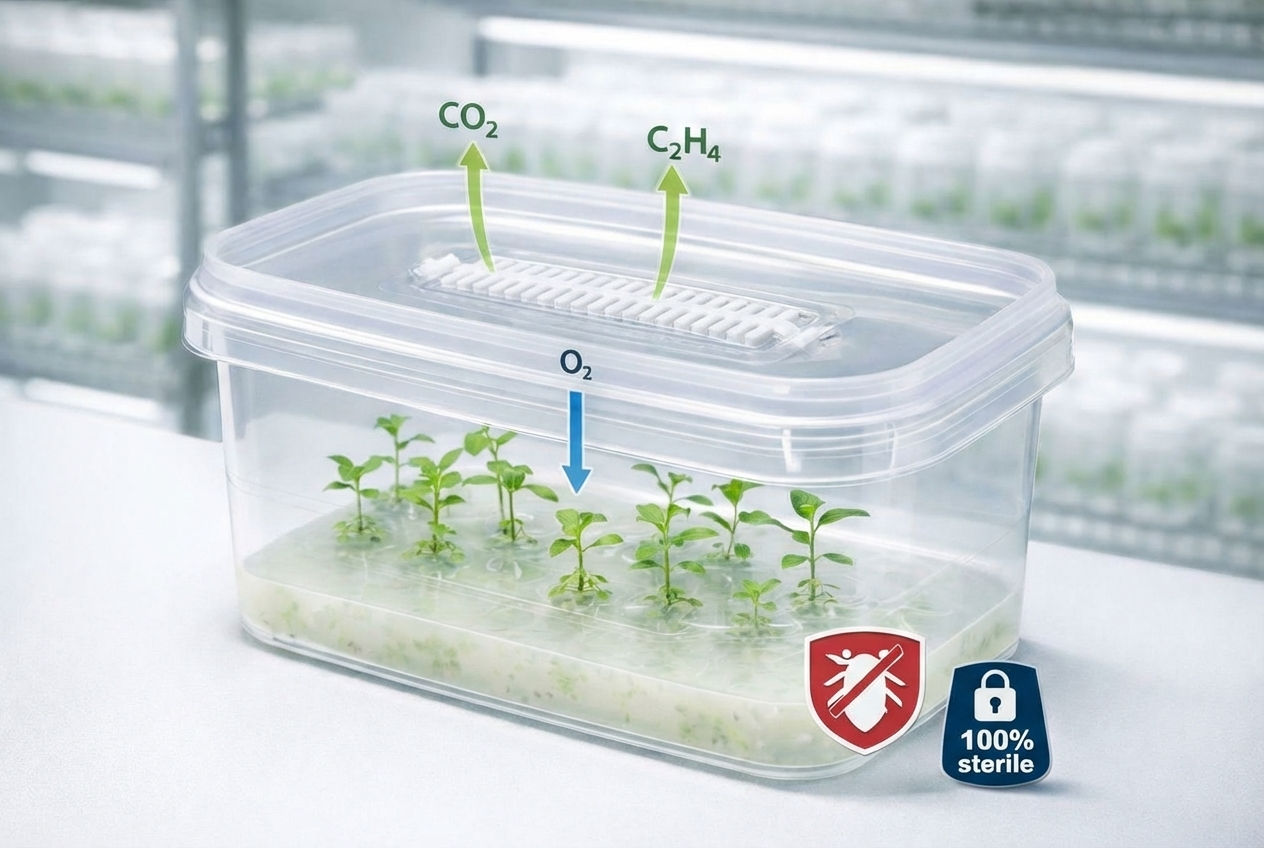
The eco2box uses depth filtration.
Flat membranes can retain a thin film of condensation during extreme temperature fluctuations or high humidity, which blocks gas exchange and causes ethylene to build up. The Eco2 depth filter maintains gas exchange much more consistently. Furthermore, the three-dimensional structure slows down physical evaporation just enough, meaning the medium dries out less quickly than with large, open-surface filters.
Reducing hyperhydration (Glassiness)
One of the biggest frustrations in laboratories is hyperhydration: a physiological abnormality in which plants absorb too much water, causing the tissue to become ‘glassy’ and brittle, and the plants to eventually die.
- Scientific studies show that high relative humidity (RH ~100%) in traditional, airtight vessels is the main cause. The plant cannot evaporate water (transpiration) via the stomata, causing sap flow to stagnate.
- Excessive evaporation, e.g. due to a flat filter, in turn leads to excessively low relative humidity (RH < 80%). The growing medium dries out, the salt concentration rises to toxic levels and toxic substances accumulate in the plants. As a result, the plants burn or scorch.
- The eco2box allows for controlled passive ventilation, which reduces the internal humidity just enough to initiate and maintain the natural transpiration flow, drastically reducing hyperhydration. At the same time, the filter ensures that the relative humidity does not become too low, so that the plants do not burn.
- As not every plant has the same requirements, filters with different permeabilities are available.